

Researching how statistics, context and behaviour influence decision quality.
Why do football statistics often fail to explain future outcomes?
Football statistics describe what happened. This investigation explores why context is often required to understand what those statistics actually mean.
- Statistical interpretation
- Context analysis
- Decision quality
- Market assumptions
Football has never produced more statistics than it does today. Every match generates thousands of data points. Possession percentages, expected goals, shots on target, dangerous attacks, pressure metrics and dozens of proprietary indicators are available within seconds of the final whistle.
For many traders and analysts, this abundance creates the impression that understanding naturally follows measurement. If enough variables are collected, the reasoning goes, better decisions should emerge automatically.
Yet football rarely behaves that way.
Every weekend, markets react to impressive statistical performances that fail to repeat themselves. Teams dominate possession and lose. Others produce mediocre underlying numbers and continue winning. Certain indicators appear highly relevant for several weeks before suddenly losing their explanatory power.
The issue is not that the statistics are wrong.
The issue is that most statistics describe what happened.
They do not necessarily explain why it happened.
The Difference Between Observation And Explanation
Statistics are exceptionally useful at documenting football matches.
They can reveal that a team averages sixty percent possession, creates more chances than its opponents or consistently generates opportunities during specific phases of play. These observations help establish what occurred on the pitch.
However, observations and explanations are not the same thing.
A team may suddenly improve its attacking output because a new manager introduced a different tactical structure. Another may experience a temporary increase in performance because key players returned from injury. A third may benefit from a favourable schedule that artificially inflates short-term results.
The numbers reflect these developments.
They do not automatically identify them.
This distinction matters because traders often mistake statistical confirmation for understanding. Once a pattern appears in the data, it is tempting to assume the cause has been identified. In reality, the data may simply be revealing the symptoms of a deeper change.
Understanding requires moving beyond what happened and investigating what created the conditions for it to happen.
INVESTIGATION MODEL
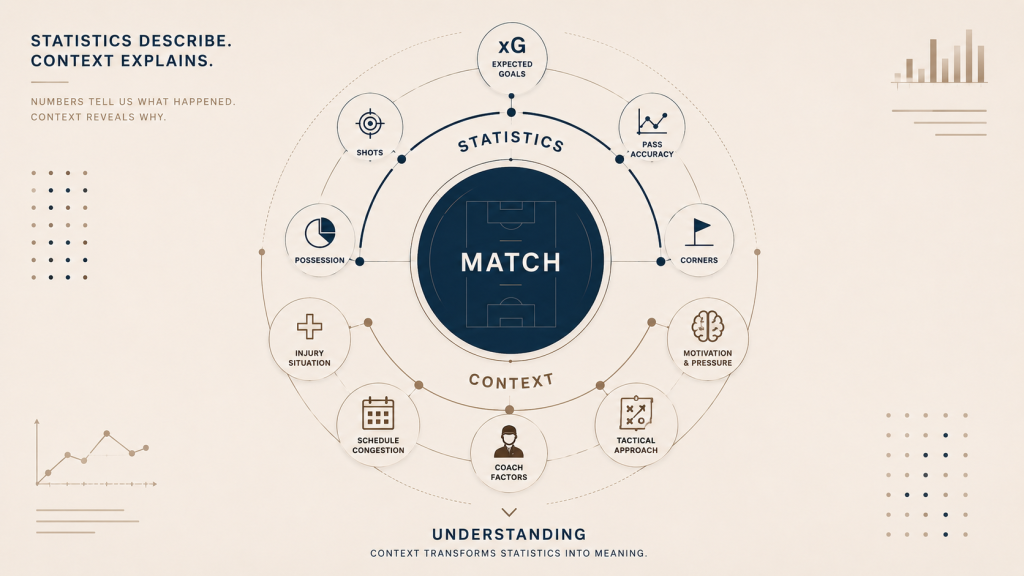
“Investigation Model — Football data describes events. Context explains behaviour.”
Context Is What Gives Statistics Meaning
A shot count without context is simply a number.
A possession percentage without context is simply a measurement.
Even expected goals, one of the most sophisticated metrics available to football analysts, becomes significantly more useful when combined with context regarding tactical structure, squad rotation, managerial philosophy and competitive environment.
The same statistic can carry completely different implications depending on the circumstances surrounding it.
Ten shots produced by an attacking side facing relegation pressure may not represent the same behaviour as ten shots produced by a title contender protecting a lead. The number is identical. The context is not.
This is why football research cannot rely solely on statistical observation.
Numbers help identify where to look.
Context helps explain what is being seen.
The strongest investigations begin when both are combined.
Conclusion
Statistics remain essential tools for football analysis. They help reduce uncertainty, reveal patterns and highlight behaviours that deserve further investigation.
But statistics are most valuable when viewed as starting points rather than final answers.
The objective is not to collect more numbers than everyone else.
The objective is to understand which numbers matter, why they matter and under which conditions they continue to matter.
Because in football, information describes reality.
Context explains it.