

Why are football traders drowning in information?
Modern football provides more information than ever before. This investigation explores why understanding remains scarce despite unlimited access to statistics, dashboards and data.
- Information abundance
- Context scarcity
- Decision quality
- Signal versus noise
Every generation of football traders believes it has access to better information than the one before it. In many respects, that belief is justified. Modern football has become extraordinarily efficient at collecting, storing and distributing data. Match statistics are updated in real time, historical databases cover thousands of competitions and analytical tools that were once reserved for professional clubs are now accessible to anyone with an internet connection. The modern trader can review shots, possession, expected goals, momentum graphs and dozens of other indicators before making a single decision.
Yet despite this unprecedented access to information, one problem remains surprisingly persistent. Traders continue to struggle with consistency. They continue to misread situations. They continue to abandon valid strategies after short periods of adversity. More information has undoubtedly improved visibility, but it has not necessarily improved understanding.
This is the paradox of modern football analysis. The challenge is no longer finding data. The challenge is deciding what deserves attention.
The Football Industry Solved The Information Problem
For most of football’s history, information was scarce. Supporters relied on newspapers, radio broadcasts and limited match reports to understand what was happening beyond their immediate environment. Even professional analysts often worked with incomplete information, making the process of evaluating teams, leagues and long-term trends far more difficult than it is today.
That reality has changed dramatically. The score is available instantly, the statistics arrive seconds later and the timeline can be reconstructed in real time from virtually anywhere in the world. Access to information is no longer the competitive advantage it once was. In fact, the modern football industry has become remarkably effective at solving the information problem.
The consequence, however, is that the industry now faces a different challenge. Every match generates hundreds of data points. Every platform competes to provide deeper statistics, more advanced models and increasingly sophisticated visualisations. Information continues to expand at a pace that far exceeds any individual’s ability to process it. As a result, many traders find themselves surrounded by information while remaining uncertain about what actually matters.
A team may score late goals in four consecutive matches and every available dataset will confirm the existence of the pattern. The statistics are clear, the recurrence is observable and the evidence appears convincing. Yet none of these elements necessarily explain why the pattern emerged in the first place. Has the manager changed his tactical approach? Is the squad benefiting from superior fitness levels? Are opponents consistently weakening late in matches? Or is the pattern simply a temporary anomaly that will disappear as quickly as it appeared?
Information can reveal that a behaviour exists. It cannot automatically explain the forces creating it.
INVESTIGATION MODEL
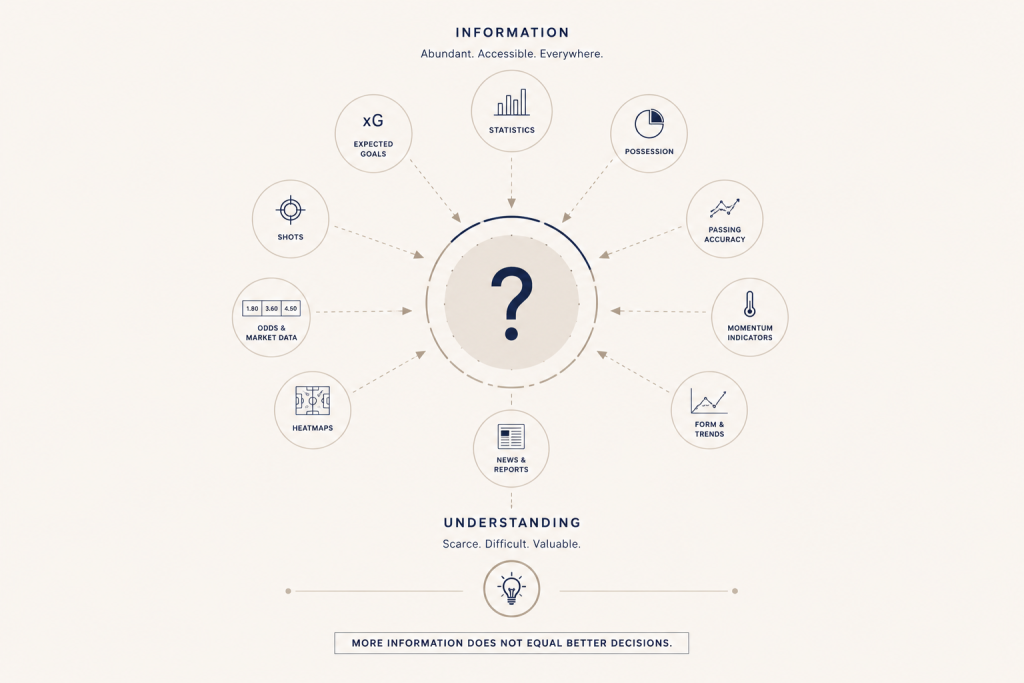
“More information does not automatically create better decisions.”
Understanding Begins Where Statistics End
This distinction becomes increasingly important as football datasets continue to grow. Most football content remains focused on describing events. A result occurs, statistics are generated, conclusions are drawn and attention quickly shifts toward the next fixture. The cycle repeats endlessly because information is easy to produce and easy to consume.
Understanding operates differently. Understanding requires investigation. It requires asking why a pattern appeared, why another disappeared and why certain behaviours persist across seasons while others collapse under scrutiny. These questions rarely produce immediate answers, but they often reveal insights that are far more valuable than the statistics that inspired them.
A tactical adjustment, a managerial change, fixture congestion, player availability or shifts in motivation can all alter the behaviour of a team long before the market fully understands what is happening. Statistics often reveal the symptoms first. Context explains the cause. The difference between the two is subtle, but it represents the difference between observation and intelligence.
Football data tells us what happened. Understanding begins when we ask why.
Conclusion
Football has never suffered from a shortage of information. If anything, it now suffers from the opposite problem. The volume of available data continues to expand while the ability to transform that data into meaningful understanding becomes increasingly valuable.
For traders, analysts and researchers alike, the next competitive advantage may not come from discovering new statistics or building more complex dashboards. It may come from developing a better ability to identify what deserves attention, what deserves investigation and what deserves deeper understanding.
Because football is not simply a collection of results.
It is a collection of behaviours.
And understanding those behaviours often matters far more than merely observing them.